Sourcing Intelligence

How a described requirement becomes a supplied component.

A general explanation of automotive seatbelt sourcing and import coordination. Every enquiry differs; the specifics of any individual transaction are confirmed with the buyer directly.

§ 01 The Sourcing File

Every enquiry opens a file. These are the fields it has to fill.

The fields below are how we structure a seatbelt enquiry. They are a working framework rather than a form — some are answered in the first message, others take a photograph or a measurement to resolve.

Enquiry Record — Structure

Form SBI / SF
01 Requirement What is needed, in the buyer's own words. A replacement for a failed component, a missing belt at a specific seating position, or a repeat requirement across several vehicles are three different problems, and they are worth distinguishing before anything else is discussed.
02 Application The vehicle and the position. Make, model, model year, body type and the exact seating position — driver, front passenger, a specific rear position. The same model can carry different arrangements at different positions.
03 Product The component definition. Category, configuration, mounting arrangement, relevant dimensions and any markings visible on the existing part. This is the field photographs contribute to most.
04 Source Where the defined product can be obtained, in what condition, in what quantity and on what terms. Options are assessed against the requirement; where the closest available option involves a compromise, that is stated rather than glossed over.
05 Documentation What paperwork the transaction involves. International purchases typically involve commercial, shipping and regulatory documentation, and the applicable requirements vary by transaction and jurisdiction. Buyers should confirm what their own use case and location require.
06 Supply Delivery of the component to the buyer, together with the product information available for it. Where the requirement is likely to repeat, the detail is recorded so the next enquiry begins from a known reference point.

§ 02

Understanding the Requirement

The accuracy of the outcome is set almost entirely by the accuracy of the input. This is the least glamorous stage of sourcing and the one that decides everything after it.

Buyers sometimes worry about not knowing the technical vocabulary. That is not a problem. A plain description of the vehicle and a photograph of the part that has failed will take an enquiry further than a technical term applied to the wrong component.

What genuinely slows an enquiry down is missing information that only the buyer can supply — which seating position is involved, whether the existing component is present or already removed, whether one unit is needed or several.

Where a requirement is urgent, saying so at the outset changes how options are presented. It is better to know early that a longer lead time is unworkable than to discover it after a source has been identified.

Two hands guiding a seat belt tongue plate into the buckle receiver beside a vehicle seat.
Ref. SBI / C-01 Tongue engaging receiver — matched pair
§ 03 Identification

Identifying the Product

Turning a described problem into a sourceable product definition. Five inputs do most of the work.

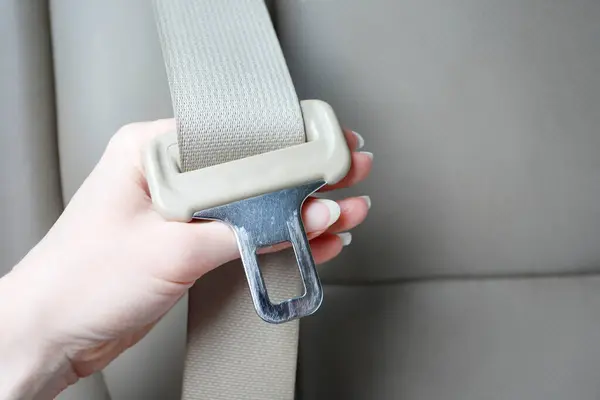
A hand holding a beige seat belt tongue plate away from the seat so the metal latch profile is clearly visible.
Ref. SBI / C-02 Tongue profile presented for identification
  • 01
    Vehicle and application

    Make, model, model year, body type and the seating position. Where a vehicle has been modified or the seating has been changed, that is worth mentioning — it changes what is likely to be fitted.

  • 02
    Product photographs

    The single most useful thing a buyer can send. Ideally: the component in place, the tongue plate square-on, the buckle receiver, the mounting point and any label or moulded marking. Ordinary phone photographs in good light are entirely sufficient.

  • 03
    Component configuration

    How the component is arranged — whether a retractor is involved, how the webbing is routed, where it anchors and how the buckle is mounted. A photograph of the whole arrangement, not only the failed part, answers most of this.

  • 04
    Dimensions where relevant

    Some requirements turn on a measurement: a length, a stalk, a bolt spacing. Where a dimension matters we will ask for it specifically, with a note on where to measure from.

  • 05
    Visible markings

    Numbers, letters, moulded codes or labels on the webbing, tongue or buckle housing. These are frequently the fastest route to a confident identification, and they are easy to photograph.

§ 04 Evaluation

Evaluating the Requirement

Once a product is defined, the question is whether a candidate component genuinely suits the application — and if not, exactly where it differs.

A

Compatibility with surrounding hardware

A restraint component works as part of an arrangement. A belt that fits the anchorage may still not suit the buckle already fitted, and a buckle that mounts correctly may not accept the existing tongue profile. Compatibility is assessed across the arrangement, not part by part.

B

Mounting and anchorage arrangement

Where and how the component attaches, and whether the candidate part is designed for the same arrangement. Differences here are usually visible in photographs of the existing installation, which is why we ask for them early.

C

Buckle and tongue pairing

Tongue plates and receivers are designed as matched pairs. Two that look alike are not necessarily interchangeable. Where a buyer is replacing one half of a pair, we establish what the remaining half is before proposing anything.

D

Retractor behaviour where applicable

Where the requirement includes a retractor, its type and behaviour need to be established rather than assumed from appearance. If this cannot be confirmed for a candidate component, that limitation is stated.

E

Condition and completeness

What is actually being supplied, in what condition, and whether every element of the arrangement is included. A component supplied without a fitting that the buyer assumed was part of it is a failed supply even if the main part is correct.

F

Quantity and consistency

Where several units are required, whether they can be supplied as a consistent set. For fleet and workshop buyers, consistency across units is frequently the point of the exercise.

§ 05 Coordination

Import Coordination

Where a component is sourced from outside India, someone has to hold the transaction together across suppliers, carriers and the paperwork that accompanies goods across a border. That coordination role is a large part of what an importer provides.

What coordination generally involves

In broad terms, an international purchase requires the commercial side and the physical side to stay aligned: what was agreed, what is being shipped, what documentation accompanies it and what has to be presented on arrival.

The buyer's practical interest is in having one point of contact who tracks all of that, rather than dealing separately with each party in the chain.

What we do not claim

We do not publish fixed transit times, guaranteed clearance outcomes or a standing list of routes, ports or countries of origin. These depend on the specific transaction, the source, the goods and prevailing conditions.

Where a buyer needs a commitment on timing or documentation, that is agreed for the individual transaction in writing — not implied by a website.


§ 06

Documentation

International and import transactions may involve commercial, shipping and regulatory documentation, depending on the transaction and the jurisdictions concerned.

Commonly this includes the commercial paperwork that records what was bought and on what terms, the transport paperwork that accompanies the goods, and whatever the receiving jurisdiction requires for goods of that description to enter.

What applies to any particular consignment is not something a website can state in advance. Requirements differ by product description, by source, by route, by the parties involved and by the rules in force at the time.

Buyers should verify the documentation and regulatory requirements that apply to their own vehicle, use case and jurisdiction, and should ask for anything they require to be confirmed as part of the transaction rather than assumed.


§ 07

Supply

The component reaches the buyer along with the product information available for it, and with a clear statement of what that information does and does not cover.

Delivery arrangements are agreed per transaction. We do not advertise standing delivery timeframes, because the honest answer depends on where the component is coming from and what is involved in getting it there.

On receipt, buyers should check what has arrived against what was described — the component itself, its condition, and whether every element of the arrangement is present.

Where a requirement recurs, the file stays useful. A workshop that sourced a component once should not have to reconstruct the identification from scratch the next time the same vehicle comes in.

Start an enquiry

Ready to open a file on your requirement?

Send the vehicle details, the seating position and photographs of the existing component. We will tell you what we can establish and what else we need.